Case Study: How Bad Logic and Fake Credibility Kept a Nation Smoking for Decades
A logical fallacies case study: anecdotal evidence, appeal to authority, and conflict of interest kept America smoking 14 years after the science was clear.
Imagine it’s the 1950s, and you’re in a room full of smart people (or at least people who are all quite sure they’re the smart one) when an argument breaks out over whether cigarettes cause cancer.
The first person says definitely not: his parents have smoked since they were teenagers and they’re both alive and well, unlike their old coworkers from the coal mines, who all got cancer. So clearly, it’s the coal industry’s chemicals doing the damage, not the cigarettes.
The second person agrees, and raises him one: even the school and college textbooks stay quiet on cigarettes causing cancer, and surely a textbook would mention something that serious if it were true. So it must be the “toxic industrial chemicals” after all.
The third person cites the cigarette company itself, which has “guaranteed,” in writing, that its product is perfectly safe to smoke.
The fourth person read it in the newspaper. Several of the country’s most respected newspapers, in fact, all saying there’s no proof cigarettes cause cancer. If anything, the papers claim smoking might increase life expectancy.
And the fifth person delivers what he considers the finishing blow: his own doctor smokes cigarettes. If they caused cancer, would a doctor smoke them?
Think About It
Before you keep reading: which of these five people sounds most convincing to you? Sit with that for a second. The fact that any of them sound convincing at all is the whole subject of this case study.
Some of these probably sound more convincing than others. All five, however, are completely flawed — and, as a matter of historical record, all five are close paraphrases of arguments people actually made.
Quick check
Which of the five arguers is leaning on a source with an obvious conflict of interest, rather than a plain logical slip-up?
That’s exactly why this case study is set in the 1950s and not today. Back then, “smoking causes cancer” wasn’t settled. It was a live, actively argued question, and the room above is a fairly accurate reenactment of how it really was argued, in public, by people who had every appearance of being reasonable.
So how good were these five arguments, really?
Not good. Here’s the report card:
- “My parents smoked and are fine, unlike the coal miners.” One family is not a study. This is anecdotal evidence: a sample size of two, asked to outweigh population-level data.
- “The textbooks don’t mention it, so it can’t be true.” Silence is not evidence of anything except, possibly, an outdated textbook. This is an appeal to ignorance: treating “nobody told me otherwise” as proof.
- “The company guaranteed it’s safe.” The company selling the product is, at minimum, not a neutral party. This is a credibility problem: an obvious conflict of interest earns extra scrutiny, not automatic trust.
- “The newspapers all say it’s fine.” Newspapers reporting confidently isn’t the same as scientists demonstrating something rigorously, especially when some of that reporting was shaped behind the scenes by industry-funded PR.
- “My doctor smokes.” One doctor’s personal habit tells you about that doctor’s personal habit. It tells you nothing about what the medical evidence shows.
Every single argument sounds reasonable on first read. None of them survive one simple follow-up question: how do you know that?
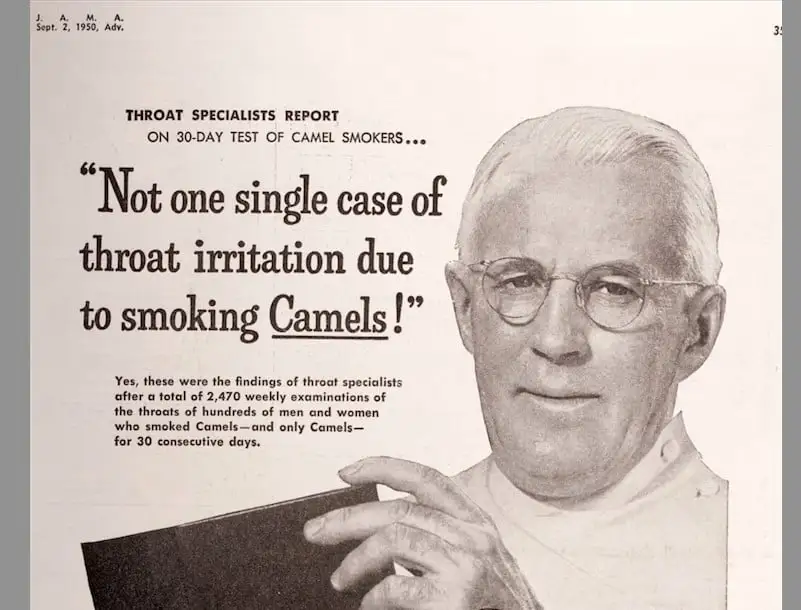
Here’s what two of those arguments were leaning on: real print advertising from the era, not a paraphrase.
The receipts
Exhibit A is one ad from a real, multi-year campaign: see Stanford’s Research into the Impact of Tobacco Advertising archive for the rest of it.
Fun facts, part one
The pattern: bad logic, fake credibility, and rhetoric doing the work
Zoom out, and the same four ingredients show up in every argument above. Illogical reasoning (the coal-miner anecdote, the silent textbook) swaps a real question for an easier one without announcing it. Borrowed or manufactured credibility (the company’s own guarantee, a doctor’s personal habit) stands in for actual expertise on the actual question. Bad sources repeat industry talking points as if they were findings. And holding it all together: confident rhetorical language, phrases like “guaranteed” and “the doctors’ choice,” a tone of total certainty that never has to show its work.
None of the five arguments needed to be true. They only needed to sound true. For a very long time, sounding true was enough.
None of the five arguments needed to be true. They only needed to sound true. For fourteen years, that was enough.
The gap between “the science” and “the official word” on smoking is the clearest evidence of just how long sounding true can hold up against being true.
How long the truth took to become official
- 1950 Doll & Hill publish one of the first major statistical studies linking smoking and lung cancer (Doll & Hill, 1950).
- 1953 Tobacco companies ramp up doctor-endorsed ad campaigns, right as the science starts closing in.
- 1954 Six major tobacco companies fund the Tobacco Industry Research Committee and run "A Frank Statement to Cigarette Smokers" in 400+ newspapers, built to keep the question looking "unsettled" in public (Wikipedia: A Frank Statement).
- 1964 The U.S. Surgeon General officially declares smoking a cause of cancer, 14 years after the first strong evidence (U.S. Surgeon General, 1964).
Sources: Doll & Hill, 1950 · A Frank Statement, 1954 · U.S. Surgeon General, 1964
Myth Busters
Myth: If a professional endorses it, it must be safe. Fact: a person’s job title tells you about their job title, not whether they’ve personally verified a health claim, and not whether they have a reason to look the other way.
Why this case study still matters
This isn’t a story about how gullible the 1950s were so much as a pattern that still runs today: take a claim that benefits someone, dress it in confident language, borrow some credibility from a lab coat or a headline, and skip the part where anyone checks. Swap out cigarettes for whatever’s being sold, endorsed, or explained away this week, and the same four questions are worth asking before you believe it: is the reasoning valid, is the source credible, is the claim well-sourced, or is it just well-worded?
Fun facts, part two
Sources: Doll & Hill, 1950 and U.S. Surgeon General, 1964 on the science-to-policy gap; Stanford’s tobacco ad archive on physician-endorsement ads; Kahan et al., 2013 on motivated reasoning, whose experiment found that giving people identical statistics to interpret didn’t reduce political polarization: it increased it, especially among the most numerate subjects.
One more scenario from this case, before you go:
Quick check
A cigarette company publishes its own study concluding its product is safe. The methodology looks fine and other researchers get similar numbers when they repeat it. Is it trustworthy?
Want the underlying mechanics behind this case? The mental shortcuts that made these five arguments feel convincing are covered in cognitive bias 101, and the three-word toolkit for testing any source (the one this case keeps circling back to) is in credibility, validity, and reliability.
Frequently asked questions
What is an example of appeal to authority?
Cigarette companies running ads where actors dressed as doctors claimed a specific brand was better for your throat, or citing a 'guarantee' from the company itself that its product was safe — leaning on a title or position instead of actual evidence.
What is anecdotal evidence?
A conclusion drawn from one person's story or experience instead of population-level data — like assuming smoking is safe because your relatives smoked for decades and are fine, while ignoring that two data points can't outweigh a large statistical pattern.
When did the U.S. government officially confirm smoking causes cancer?
1964, in the Surgeon General's report — 14 years after Doll and Hill's 1950 statistical study had already shown a strong link between smoking and lung cancer.
What is a conflict of interest in research?
When whoever is making or funding a claim has something to gain from you believing it — like a cigarette company publishing its own 'safety' research. It doesn't automatically make a finding false, but it's a reason to check whether independent researchers get the same result.
Ready to think like this on purpose?
Alekhni's programs and writing tools are built to turn this kind of thinking into a habit.
Keep reading
 AI in education
 Teachers vs. AI: Welcome to the Classroom Detective Era
Do AI detectors actually work? Read research on false positives, what the IB's AI policy says, and why punishing AI use may not be the best solution.
Read more → Research Skills
 Citations 101: The Hows, Whats, and Whys of Citations
What a citation actually does, why academic writing requires one, and what the Citation Project's research found about how students really read and cite sources.
Read more → Critical Thinking
 Cognitive Bias 101: Your Brain Is Kind of Lying to You
Cognitive bias examples students recognize: confirmation bias, hindsight bias, black-and-white thinking, and authority bias, explained with real research.
Read more →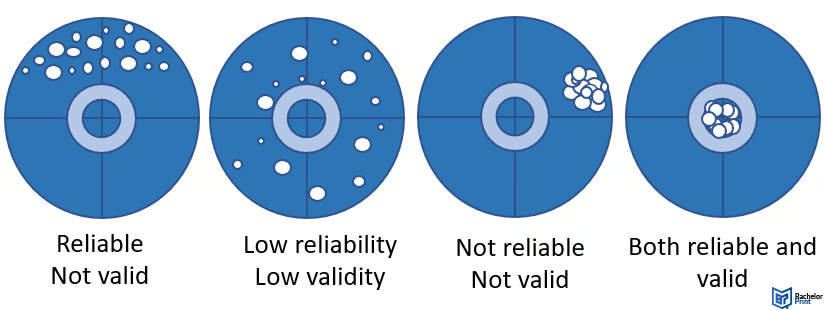 Critical Thinking
 Wait, Can I Actually Trust This? (A Guide for People Who Doomscroll)
The difference between reliability, validity, and credibility, explained in plain English, with real examples and research on how to evaluate any source.
Read more →