Cognitive Bias 101: Your Brain Is Kind of Lying to You
Cognitive bias examples students recognize: confirmation bias, hindsight bias, black-and-white thinking, and authority bias, explained with real research.
Being smart does not save you from this. That’s the annoying part. Smart people don’t fall for bad reasoning less; they just construct fancier, more convincing justifications for whatever they’d already decided to believe. Researchers call this “myside bias.” When they went looking for a link between it and raw intelligence, they mostly didn’t find one: smarter people are just as prone to it, merely more skilled at making the excuse sound rigorous (Stanovich, West & Toplak, 2013). Your brain isn’t trying to trick you. It’s conserving energy, and thinking carefully about everything, all the time, is exhausting, so it cheats. Constantly. Using shortcuts called cognitive biases.
Most of the time the cheating is harmless. You don’t need a full logical audit before deciding whether to cross the street. The trouble starts when those same lazy shortcuts get aimed at questions that deserve real thought.
Think About It
Quick gut check before we go further: when’s the last time you were 100% sure about something, said it out loud with total confidence, and then turned out to be wrong? What did that feel like in the moment: certainty, or did some tiny part of you already suspect?
The bias you’ve probably already used today
Say you post an opinion, then spend the next hour checking if people agree. Every like feels like proof. Every reply that pushes back feels like it’s missing the point, so you barely register it. That’s confirmation bias: you don’t just believe what confirms your view, you go out and hunt for it, and your brain conveniently forgets the search was rigged from the start. It’s one of the most heavily documented patterns in psychology, showing up in memory, reasoning, and even how people search for information online (Nickerson, 1998).
It gets sneakier than liking your own posts, too. Ever notice how once you decide you don’t like a song, every time it comes on you find a new reason to be annoyed by it? Or how once you’ve decided a teacher “has it out for you,” every grade just… confirms that? You’re not making that up out of nowhere. You’re just not looking very hard for the version of events where you’re wrong.
Quick check
Someone says: 'I looked it up and found three posts backing up what I already thought, so I must be right.' What's actually going on here?
Pro Tip
Cheap trick that works: before you lock in a belief, go looking specifically for the best argument against it, not the weakest one. If you can’t find one, or can’t explain why it’s wrong, hold the belief a little more loosely than you were about to.
Once you know the answer, you can’t remember not knowing it
Here’s a weird one. The second you learn how something turns out, your brain silently rewrites your memory so the outcome feels like it was obvious all along. That’s hindsight bias, first demonstrated experimentally when researchers had people predict the outcome of real political events, then asked them afterward to recall their own predictions. People consistently “remembered” being far more confident in the correct outcome than they had been beforehand (Fischhoff & Beyth, 1975). It’s the reason people watch a plot twist and go “I totally called that” when, be honest, they did not call that.
It’s also why looking back at people who were confidently wrong about something (in any decade, about anything) makes them look almost comically dumb in hindsight, even though a reasonable person living through it at the time might not have caught the flaw. Knowing the ending is a superpower your past self didn’t have.
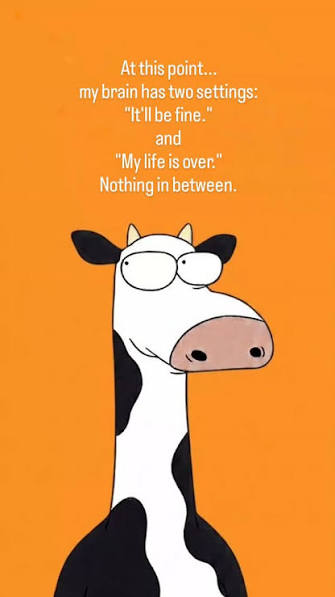
Speaking of not being able to unsee something, look at that cow up top again.
Once your brain locks onto “it’ll be fine” or “my life is over,” with nothing in between, that’s a legitimate, has-a-name bias: dichotomous thinking, or black-and-white thinking if you prefer the plainer version. The psychiatrist Aaron Beck first cataloged this pattern in his research on distorted thinking back in 1963 (Beck, 1963). Your brain skips right past “this is mildly annoying and will probably work out with some effort” and jumps straight to a season finale. It’s a shortcut like the others: nuance takes longer to compute than an extreme, so under stress your brain doesn’t bother rendering it.
Think About It
Be honest: do you do this? Test grade, group project, text that took too long to get a reply: does your brain offer you the calm, reasonable middle option, or does it go straight to one of two extremes? What usually triggers it for you?
The bias that runs on vibes and letterhead
Last one: if someone shows up with a title, a badge, a verified checkmark, or a white coat, you’re wired to believe them faster, even when that exact person has an obvious reason to want you to believe them. This is authority bias, and it runs on packaging more than information. It’s the same instinct a famous, unsettling 1963 experiment found could push ordinary people to keep administering what they believed were increasingly painful electric shocks to a stranger, simply because someone in a lab coat calmly told them to continue (Milgram, 1963).
A random account claiming a supplement “boosts your metabolism by 300%” gets ignored. The same claim, from someone captioned “Dr. So-and-So,” gets screenshotted and sent to the group chat. Nobody checked whether the doctor has any relevant expertise, got paid to say it, or is even a real doctor. The title alone did most of the convincing, unnoticed, before anyone thought to ask a follow-up question.
Quick check
An account with 'Dr.' in the bio posts that a specific tea 'detoxes your liver overnight.' What's the smartest next move?
Myth Busters
Myth: if you’re aware biases exist, you’re basically immune to them. Fact: knowing the list doesn’t switch them off: it just gives you a slightly better chance of catching yourself mid-shortcut, sometimes, if you’re paying attention. Which, respectfully, you often aren’t. Nobody always is.
So why does any of this matter for reading and writing
Citing sources, double-checking claims, asking “wait, how do we know that”: none of it is busywork. It’s a system built to slow down and catch the exact shortcuts covered above, the ones your brain takes automatically, for free, without asking permission first.
Want to see all of this play out at full scale, a whole room of confident people all reasoning badly in slightly different ways? That’s the cigarette case study. Once you’re good at spotting a biased argument, the next move is telling a trustworthy source from one that just sounds trustworthy. That’s credibility, validity, and reliability.
Frequently asked questions
What are the most common cognitive biases?
The ones people run into constantly are confirmation bias (favoring information that confirms what you already believe), hindsight bias (feeling like an outcome was obvious after the fact), black-and-white thinking (skipping the middle ground between two extremes), and authority bias (trusting a claim more because of who said it, not what they said).
Does being smart protect you from cognitive bias?
Not really. Research on myside bias has found only a weak link to intelligence — smart people fall for the same biases as everyone else, they're just better at constructing convincing-sounding justifications for it.
What is an example of confirmation bias?
Searching for posts, articles, or opinions that back up something you already believe, while barely registering the ones that push back — then treating the one-sided pile of 'evidence' you found as proof you were right all along.
Can you unlearn a cognitive bias once you know about it?
Not permanently — knowing the list of biases doesn't switch them off. What it does is give you a slightly better shot at catching yourself mid-shortcut, sometimes, if you're paying attention. The goal isn't immunity, it's catching more of them, more often.
Ready to think like this on purpose?
Alekhni's programs and writing tools are built to turn this kind of thinking into a habit.
Keep reading
 AI in education
 Teachers vs. AI: Welcome to the Classroom Detective Era
Do AI detectors actually work? Read research on false positives, what the IB's AI policy says, and why punishing AI use may not be the best solution.
Read more →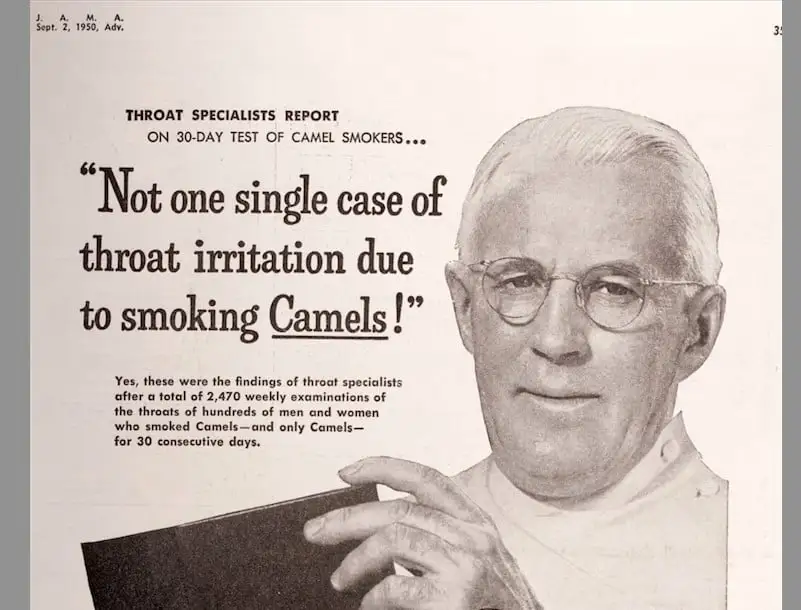 Case Study
 Case Study: How Bad Logic and Fake Credibility Kept a Nation Smoking for Decades
A logical fallacies case study: anecdotal evidence, appeal to authority, and conflict of interest kept America smoking 14 years after the science was clear.
Read more → Research Skills
 Citations 101: The Hows, Whats, and Whys of Citations
What a citation actually does, why academic writing requires one, and what the Citation Project's research found about how students really read and cite sources.
Read more → Critical Thinking
 Wait, Can I Actually Trust This? (A Guide for People Who Doomscroll)
The difference between reliability, validity, and credibility, explained in plain English, with real examples and research on how to evaluate any source.
Read more →